
Voracious Varmint
Invasion of the nutria.

Get out of here, you varmint!
You’re ruining our swamps!
You are a pesky rodent
that no one really wants.

Some think you are a beaver,
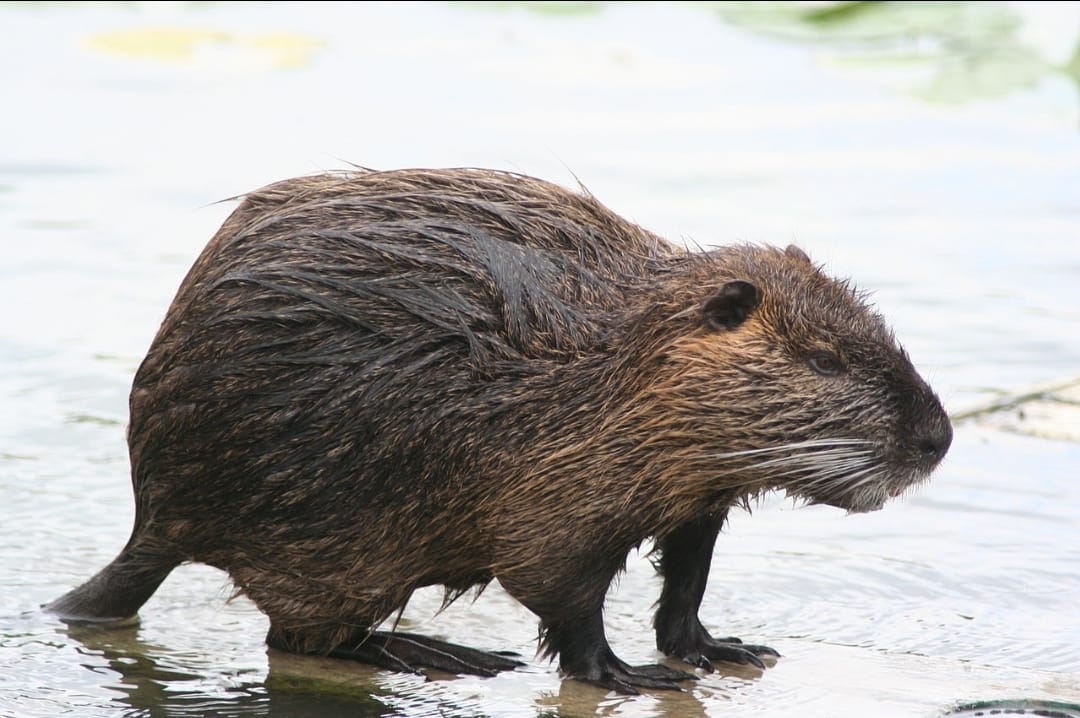
but you’re a swimming rat
You’re one prolific breeder,
less cute than a muskrat.

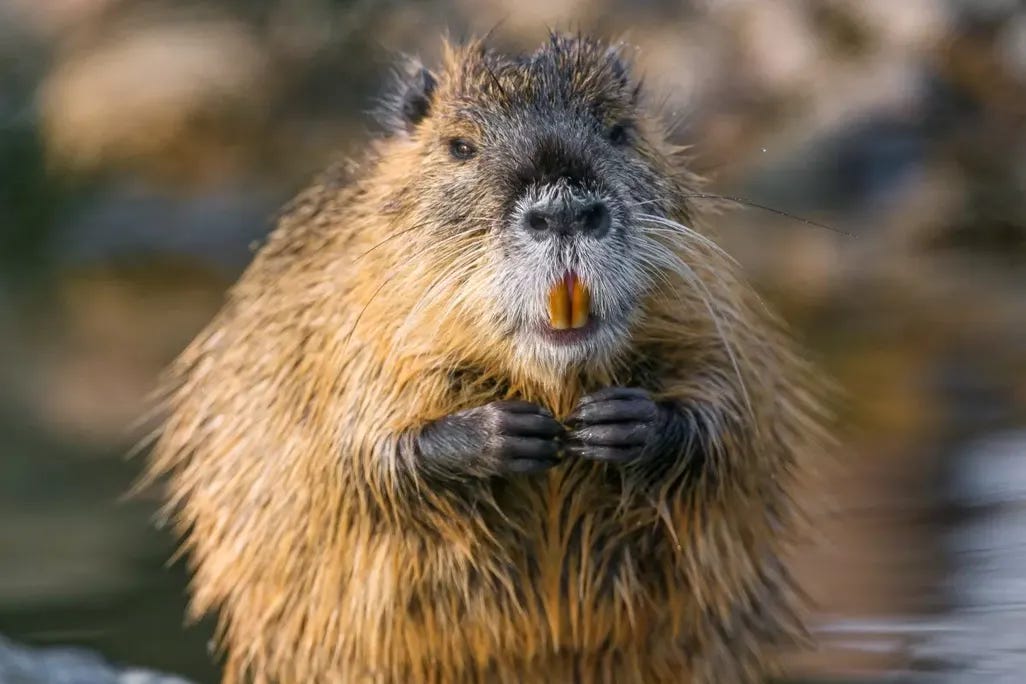
Your front teeth are bright orange,
your coat a brownish pelt,
voracious when you forage,
destructive as all hell!

You came here for the fur trade
from South America,
but now, much to our dismay,
too many nutria!

No ocelots, no pumas
to catch you and then munch.
We don't have anacondas
to swallow you for lunch!

You chew up roots and tubers
of plants you decimate,
your appetite is uber,
the swamps you desecrate.

The levees now you’re breaking,
plus dikes and dams and roads,
through tunnels you are snaking
and coasts you will erode.

Louisiana bayous
and coastal states out west,
and everywhere we find you,
you are an awful pest.

You ravage streams and wetlands
and also spread disease,
then chew up precious farmlands,
so we are much displeased!

So, sorry if we shoot you
or trap you in a cage.
Our bulldozers unroof you
to control your rampage.

Your presence is destructive,
your fur, we hardly need.
Our plan's therefore reductive,
removing you with speed.

You're an invasive species
and live in the wrong place,
so say goodbye, you beasties
and get out of our face!
April  11 NaPoWriMo prompt (thanks, Alex Dawson, https://substack.com/@alexdawcreates): Research a local animal. Write a poem for them, incorporating at least one interesting fact.

I wasn't intending to write a poem related to this prompt, as the local animals in my area consist of rescued pit bulls, tabby cats and white-tailed deer,  which aren't necessarily the greatest poem fodder.  However, just after reading this prompt, I came across an article from California, not in my area but at least in my country, where nutria have become invasive and are threatening both the environment and agriculture.  I remember as a kid seeing fur coats made from nutria pelts, but since fur went out of style, I've never heard much about this animal. It has been a big problem in parts of the United States, however.

So what's a nutria?  It's a large, semi-aquatic fresh and saltwater rodent that is native to South America, also called a coipú or a ratão-do-banhado ("big swamp rat"). It's known for its large, orange teeth, dense beaver-like brown or yellowish fur, its long, almost hairless, skinny black tail and webbed back feet.  The animal is native to Argentina, Chile, Paraguay, Uruguay, and southern Brazil, where it has natural predators like large cats (jaguars, pumas, ocelots), reptiles (caimans and anacondas), foxes, wolves, birds of prey and giant otters.  It grows to about 20 pounds, eats about a quarter of its weight in vegetation every day and reproduces at least three times a year, with up to 13 offspring per female per litter.

Nutria were imported to North America in the 1890's, mostly to California, Ohio and Louisiana and were farmed for their pelts to make fur coats.  When the fur industry collapsed in the 1940's and farmers could no longer afford to feed them, some nutria were released into the wild and became feral populations, now residing in some 18 U.S. states.  Here's the current distribution: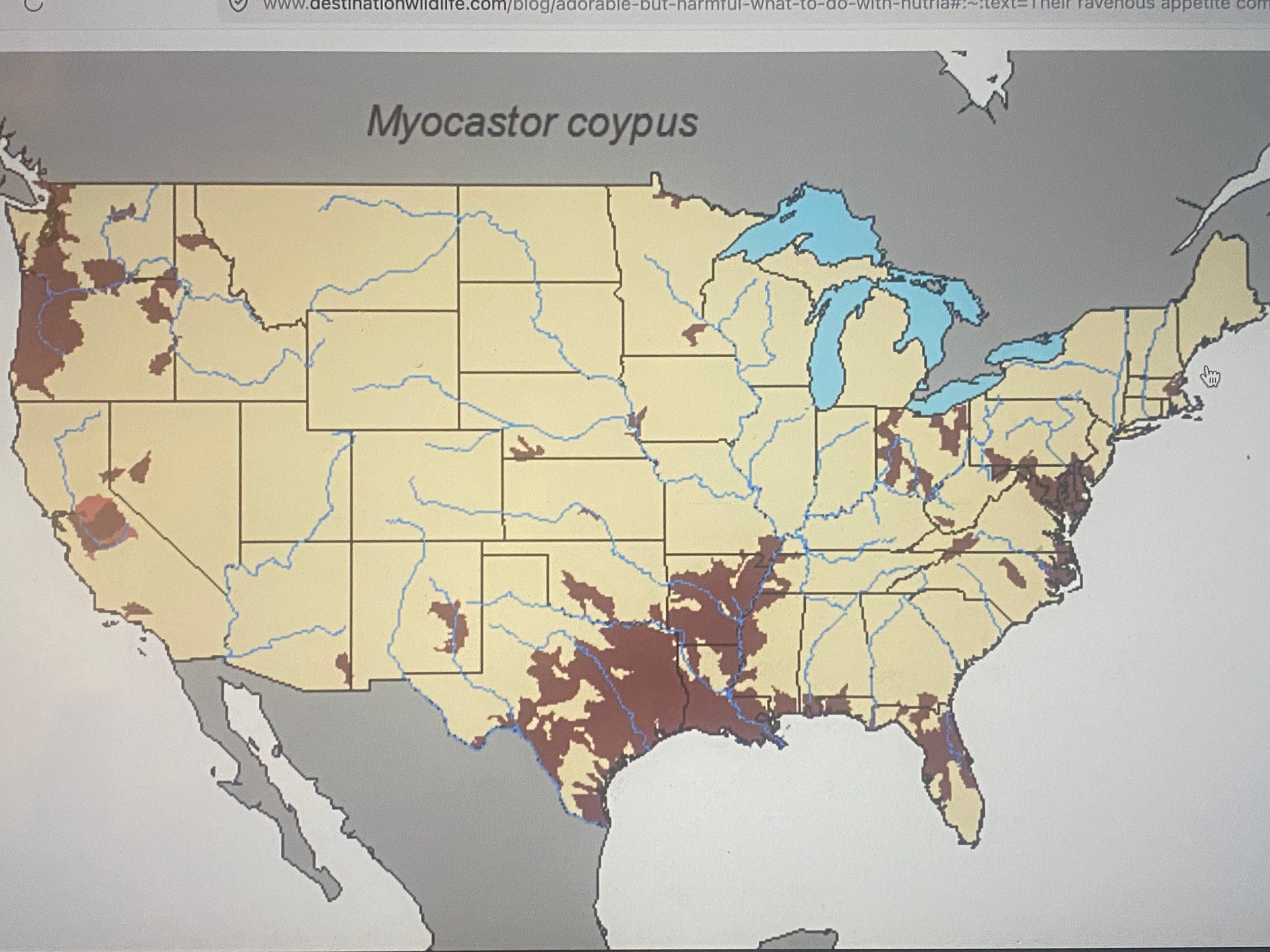
\(//////\)
Some nutria were released intentionally to increase fur yields or because they were thought to be helpful in reducing swamp vegetation, while others were scattered freely during hurricanes.  With fewer predators to limit multiplication in their transplanted environment, these creatures began destroying it by consuming natural wetland and coastal vegetation,  disturbing a fragile ecosystem, creating opportunity for land erosion along riverbanks and swamps, and burrowing into the ground, up to 20 feet.  This can compromise structures like levees, dams, road beds and irrigation tunnels, leading to flooding and collapse.

Although nutria have been virtually eradicated in some areas like Maryland in the Delmarva Peninsula through longstanding programs to remove them, and California once also had eliminated their population, nutria now have reappeared in California, probably because of human intervention and re-introduction from adjacent Oregon.  Nutria are voracious eaters, and they especially like to devour rice and sugar cane crops, in addition to sugar beets, corn, milo, wheat, barley, and peanuts. They also girdle trees, particulary the nut and cypress varieties, removing the lower bark and rendering them non-viable.

Affectionately termed "swamp rats" in Louisiana, where hundreds of thousands of acres have been destroyed by consumption of native plants and tree roots, leading to tidal erosion, the state offers a bounty of  six dollars per nutria captured, and in order to save the rest of the wetlands, Louisiana's evenutal goal is to eliminate 400,000 nutria from the state.  Nutria are edible, much like rabbit, and their fur still garners $4/pelt, despite the continually lowered demand for fur in the U.S.

It's too bad we have to hunt and trap so many of these animals, but without a lot of predators, it's probably the best we can do to reduce their population and protect the environment at this point.  Perhaps in years to come, we'll figure out other ways of managing their populations.
Great poem, and a really good story. A friend who has one says nutria fur coats are really warm and comfortable, but the downside is clear. Pity we can't introduce them to kudzu and take care of two invasive species at the same time.
Wow, I just learned something new. Interesting! And you're quite good at rhyming. I might have a job for you. ;)